Every Link Is a Promise: The Quiet Trust Problem Hiding in Your Link-in-Bio

Here is the most uncomfortable thing about your link-in-bio page. Every single button on it is a tiny promise.
"Shop" promises a shop. "Newsletter" promises a newsletter. "New Podcast Ep" promises a new podcast episode, today, not three weeks ago. "Book a Call" promises a calendar, not a form that asks for your email first so you can be added to a drip sequence. "Latest Video" promises a video, not a landing page for a course you launched in February.
The people tapping those buttons do not read your captions. They do not remember your pinned post. They have about two seconds of patience, one thumb, and one expectation — and that expectation is whatever word you put on the button. If the thing on the other side doesn't match, they don't get angry. They don't email you. They close the tab, and they tap a little more slowly the next time they see your name.
That, quietly, is the part of the creator funnel nobody is optimizing. Every missed promise chips away at a number you can't see in any dashboard: the probability that a person who has tapped one of your links before will tap another one.
The part of conversion nobody measures
When people talk about optimizing a Liinks page, they usually mean design things. Theme. Button color. Ordering. A custom cover. More recently: click-through rate and which sections people actually use.
Those all matter. But there is a layer underneath them that almost nobody talks about, because it doesn't show up in analytics and it doesn't have a nice name. Call it link fidelity — how well the thing on the other side of a link matches the promise on the front. A link with high fidelity delivers exactly what the label implies, in the shape the person expected, at the speed they expected.
A link with low fidelity is a small betrayal. Not a big deal the first time. Inconvenient the second. And by the third, you've trained your most engaged fans — the ones who actually tap things — to distrust your links. They still follow you. They still "engage." They just don't act.
Here's the brutal part: you almost never find out. There is no "trust score" dashboard. The person who got burned doesn't post about it. They just hit a soft ceiling on how much they will ever convert, and you never find out why your evergreen offer isn't moving anymore.
The four small betrayals I see every week
I look at a lot of link-in-bio pages. These four patterns come up constantly, and every one of them is a trust leak.
1. The "Shop" button that goes to a 404 of a product you sunset in 2024
You changed your Shopify URL. You sunset a product. You moved a service page. You forgot one link. Now "Shop" goes to a page that says "Sorry, this item isn't available" — or, worse, a broken URL.
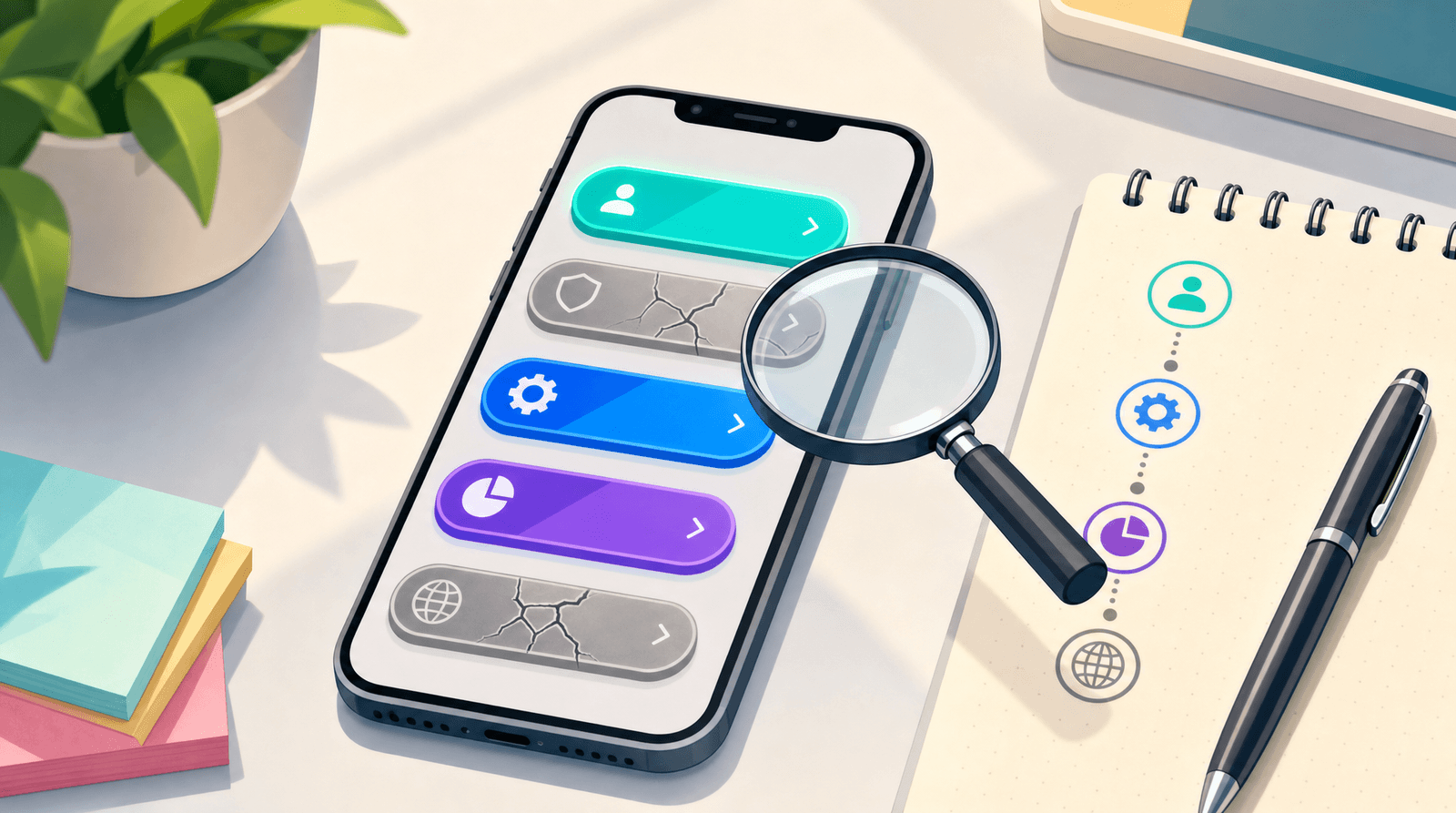
This is the cheapest trust leak to fix and the most common one I find. Audit monthly. Click every button. If you have a lot of links, UTM tags make this easier because a link that suddenly stops sending clicks is usually a dead link, not a dead audience.
2. The button named after the destination, not the thing the person wanted
"YouTube." "TikTok." "Instagram." These labels describe the platform, not the content.
The follower tapping that button is already on one of those platforms. They don't need a connection back to the general abstract concept of your YouTube channel. They wanted to watch your latest tutorial, or see the video you just posted about. Label accordingly.
"Watch: How I Built My Newsletter in 30 Days" is a kept promise. "YouTube" is an ambient shrug.
3. The "Newsletter" button that is actually a landing page
There is a specific flavor of disappointment when you tap "Newsletter" expecting to see the newsletter — past issues, a taste of the voice, a reason to trust this person with your inbox — and instead you get a splash page with a big field that says ENTER YOUR EMAIL.
The audience isn't wrong for expecting what you promised. You either:
- Relabel the button to "Subscribe to my newsletter" (kept promise — they know a form is coming), or
- Link to the archive/index and let the form live there (kept promise — they see the newsletter before signing up).
Both work. The in-between — a button called "Newsletter" that hides everything about it behind a signup wall — does not.
4. The "Latest" that hasn't been latest in months
"Latest Video." "New Podcast Ep." "Just Launched." These labels come with a timestamp baked in, and time breaks them automatically.
If the link is going to age, either automate it (link to a channel, a playlist, a tag) or accept the maintenance cost. Labels like "Most-played episode" and "Watch my most-watched video" age gracefully. Labels like "Brand new ✨" do not.
Why this matters more now than five years ago
Two things changed.
The first is that the average person is getting link-in-bio'd by dozens of creators, brands, and friends every week. The muscle memory of "I tapped a link-in-bio button and it didn't give me what the label said" is now a trained reflex. Audiences are faster to bounce than they used to be, and they're doing it across every creator, not just you.
The second is that every platform is now burying, suppressing, and throttling links that try to leave their walled garden. That means the link-in-bio page itself has quietly been promoted. It's no longer a side-door. For a lot of creators, it's the only door. So the trust cost of a broken or dishonest link is higher than it used to be — because there is no second chance from that platform's feed. If a fan bounces off your bio page, they're gone.
Put differently: the links on your Liinks page are doing a job that used to be shared across four or five surfaces. They deserve the care you used to spread across all of them.
What a trust-first link-in-bio actually looks like
I've been workshopping a rough rubric with creators for the last few months. Nothing fancy. If you can answer these four questions with a clean "yes" for every button on your page, you are already well above average:
- Does the label describe the thing behind the link, not the platform, brand, or format? ("Watch my morning routine" beats "YouTube.")
- Does the thing behind the link appear in the first screen a person sees, with no interstitial, popup, or modal between them and it? (If they have to scroll past an email capture to see what you promised, the link has low fidelity.)
- Is the label still accurate if this button is still here in six weeks? (If it has "new," "latest," "just dropped" in it, you've set a calendar for yourself.)
- If a new follower tapped this cold, with no other context, would they feel you delivered what you said? (This is the important one. Don't audit your page as yourself. Audit it as the most skeptical person in your audience.)
A page that answers yes to all four every time doesn't go viral. But it quietly trains the audience that your links, specifically, are the ones worth tapping. Over months, that compounds into something that looks a lot like luck — your offers convert better than other people's, your newsletter signup rate is "surprisingly" high, your launches hit.
The fixes are embarrassingly small
None of this requires a redesign. No new platform. No batch of AI tools. The interventions that buy back the most trust are almost humiliatingly minor:
- Rename every button so it describes the destination. Spend ten minutes on this. Most pages get measurably better.
- Click every one of your own links on your phone, not your laptop. Pretend you've never seen your own page. Notice the first full second after the tap. If you feel even a flicker of "wait, where am I" — a stranger felt it too, and they felt it more.
- Set a recurring reminder — monthly is plenty — to audit dead links. Products sunset. URLs change. Platforms move. This is maintenance, not strategy.
- Kill "Latest" unless you're actually updating it weekly. If you don't have the bandwidth, use timeless language: "Most-shared episode," "Popular right now," "Our best-selling product." Those stay honest.
- Preview your own share cards. The promise also lives in what your shared links look like in DMs and timelines — the thumbnail, the title, the description. We built a free Open Graph debugger so you can see every one of your links the way your audience does, in about ten seconds. A lot of broken promises are hiding in that preview.
- Watch your Liinks button analytics with "fidelity" in mind, not just click volume. A button that gets a lot of clicks but weak downstream action is often a promise-mismatch, not a conversion problem.
You will be surprised how much of this is in the power of the person writing the labels — not in the hands of a designer, not in the theme, not in the platform. The words you put on the button are the contract.
The real idea
Every time a follower taps one of your links and gets what the label promised, you make a tiny deposit in their account with you. Every time they tap and don't, you make a tiny withdrawal. Most creators never notice the withdrawals, because they come in the quietest possible form: nothing. A closed tab. A missed reply. A fan who stops tapping.
The people who build sustainable audiences online are the people whose links you can trust. Not because they have the best design or the cleverest copy — but because they've earned, button by button, the right to be tapped.
Your Liinks page can do that for you. But only if you treat each link the way your audience already, secretly, does: as a promise.
TL;DR
- Every link on your bio page is a tiny promise to the person about to tap it.
- When the destination doesn't match the label, you don't get a complaint — you get quiet, invisible churn.
- The four most common trust leaks: dead links, platform-named buttons, "Newsletter" buttons that hide behind signup forms, and "Latest" labels that aren't.
- The fix is almost entirely in the words on the button — not the design, the theme, or the tool.
- Run every button through four questions: is the label accurate, does the destination deliver it immediately, is it still accurate in six weeks, and would a skeptical new follower say you kept the promise?
Audit yours in the next ten minutes
Open your Liinks page on your phone. Tap each button, one by one, with the four questions above in front of you. Rename anything platform-named. Kill anything labelled "new" that isn't. Watch what happens to your click patterns over the next two weeks.
If you don't have a Liinks page yet, start a free one — the clean section system and button-level analytics are designed to make exactly this kind of ongoing promise-auditing fast. Your most-engaged followers are already rating your links. You might as well be the one deciding what they're rating them on.