How to Monetize a Small Audience: A Practical Guide for Creators Under 10K

There's a lie the creator economy keeps telling you: you need a big audience before you can make money.
It sounds logical. More followers equals more eyeballs equals more revenue, right? So you grind for months chasing the algorithm, obsessing over follower counts, and telling yourself you'll "start monetizing once you hit 10K." Meanwhile, creators half your size are quietly paying rent from their link-in-bio pages.
The math isn't broken. Your strategy is. A small, engaged audience is one of the most valuable assets you can have online — but only if you know how to convert it. Here's the practical playbook.
Why Small Audiences Are Secretly Powerful
Let's start with some numbers that might surprise you.
A creator with 50,000 followers and a 0.5% conversion rate gets 250 actions per campaign. A creator with 3,000 followers and a 5% conversion rate gets 150 — and those 150 people are far more likely to buy again, refer friends, and stick around for the long haul.
Engagement rates almost always decrease as audience size grows. The bigger the crowd, the more passive lurkers dilute your core fans. But when your audience is small, the people who follow you actually chose to be there. They read your captions. They tap your links. They reply to your stories.
This isn't a consolation prize. It's a strategic advantage.
Small audiences give you three things big audiences can't:
- Direct relationships. You can DM every customer. You know their names. They feel seen.
- Fast feedback loops. You can test a product idea on Monday and have real feedback by Wednesday.
- Higher trust per capita. Your recommendations carry weight because people see you as a peer, not a celebrity.
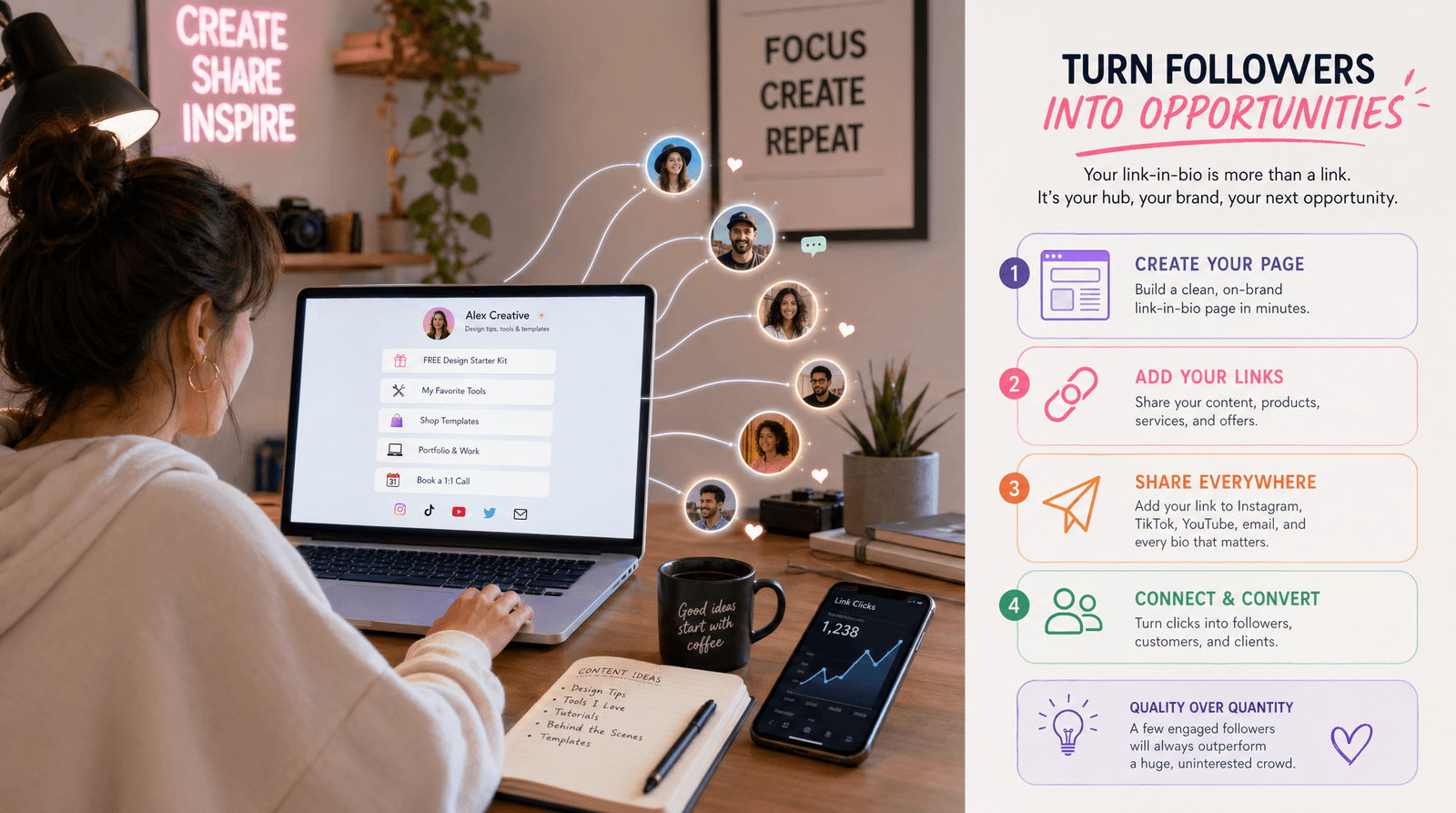
The key is designing your online presence — especially your link-in-bio page — to capitalize on that trust instead of wasting it with a messy pile of random links.
Step 1: Pick One Revenue Stream and Go Deep
The biggest mistake small creators make is trying to do everything at once. Affiliate links, digital products, coaching, merch, ad revenue, memberships — it's overwhelming, and splitting your energy across six things means none of them work.
Instead, pick one revenue stream that matches your audience and your skills:
If your audience asks you questions → Sell knowledge
This could be an ebook, a template pack, a mini-course, or a paid workshop. If people are already DMing you for advice, you have product-market fit — you just haven't packaged it yet.
If your audience trusts your taste → Curate and recommend
Affiliate marketing works exceptionally well for small creators because the recommendations feel personal, not sponsored. A fitness creator with 2,000 followers who recommends specific gear will convert better than a mega-influencer doing a scripted #ad.
If your audience needs your hands → Sell your time
Coaching calls, consulting sessions, freelance services, audits. When your audience is small, one-on-one work is the fastest path to real revenue because you don't need volume — you need a handful of clients who value your expertise.
If your audience is loyal → Build recurring revenue
A paid community, a membership, or a subscription newsletter. Even 50 people paying $10/month is $6,000 a year. That's not pocket change — especially when the people paying are genuinely engaged.
Pick the one that feels most natural. You can always add more later, but only after the first one is working.
Step 2: Structure Your Link-in-Bio as a Conversion Page
Here's where most small creators leave money on the table. They treat their link-in-bio like a filing cabinet — a flat list of every link they've ever shared. But when you're monetizing a small audience, your bio page isn't a directory. It's a landing page.
Every visitor who taps your bio link is showing real intent. They left their feed, left the content, and voluntarily navigated to your page. That's the highest-intent traffic you'll ever get for free. Don't waste it on a wall of twelve equally-weighted buttons.
With Liinks, you can structure your page like a conversion funnel:
Top of page: Your best offer. This is the thing you most want visitors to do right now. A featured product, a free lead magnet, a booking link. Make it visually prominent — use a hero section or a highlighted button.
Middle: Supporting context. Testimonials, social proof, a short description of what you do. This is where you build credibility for visitors who aren't ready to buy yet. Liinks sections let you add text blocks, images, and embedded content that tell your story without cluttering the page.
Bottom: Everything else. Your social links, your portfolio, your "about me" page. Important, but secondary. These are for the browsers, not the buyers.
This structure works because it respects how people actually make decisions. They see the offer, they evaluate trust, they act (or they don't). If you've read Every Link Is a Promise, you know that each button on your page is a micro-commitment — and the best pages make those commitments feel easy and worthwhile.
Step 3: Create a Lead Magnet That Earns Trust Before You Ask for Money
Not everyone who taps your bio link is ready to buy. That's fine — but you need a way to stay connected with them after they leave your page.
A lead magnet is something free and genuinely useful that you offer in exchange for an email address. It's the bridge between "casual follower" and "future customer." For small creators, this is especially powerful because you can make it feel personal rather than mass-produced.
Great lead magnets for small audiences:
- A one-page cheat sheet related to your niche (faster to consume = higher conversion)
- A short video tutorial that solves one specific problem
- A template or swipe file people can use immediately
- A free chapter or sample of a larger paid product
- An email mini-course (3-5 emails over a week)
The goal isn't to create something massive. It's to create something so useful that the person thinks, "If the free stuff is this good, the paid stuff must be worth it."
Put your lead magnet link at the top of your Liinks page with a clear, specific CTA. Not "Sign up for my newsletter" (boring) — try "Get the free template" or "Download the 5-minute guide." If you need help writing CTAs that don't feel pushy, The Non-Awkward Ask has a framework that works well for this.
Step 4: Use the "100 True Fans" Framework
Kevin Kelly's famous "1,000 True Fans" essay argued that a creator only needs 1,000 people willing to spend $100/year to earn $100K. But for small creators just getting started, even that number can feel daunting.
So start smaller. Think about your first 100 true fans — people who will spend $50-200 over the next year if you give them something worth buying.
100 fans × $100/year = $10,000. That's a meaningful start.
Here's how to find and cultivate those 100 people:
- Identify your most engaged followers. Who comments regularly? Who DMs you? Who shares your content? These are your warmest leads.
- Talk to them directly. Ask what they're struggling with. Ask what they'd pay for. Small audiences make this possible in ways that big ones don't.
- Build in public. Share your process of creating the thing they asked for. When they feel ownership over the product, they'll buy it on day one.
- Make the first offer feel exclusive. "I made this for the 50 people who responded to my story poll" converts better than "NEW PRODUCT AVAILABLE" blasted to everyone.
This is the advantage of small. You can make every customer feel like a founding member instead of a transaction.
Step 5: Optimize for Revenue Per Visitor, Not Total Traffic
When your audience is small, the metric that matters isn't how many people visit your page — it's how much value you extract from each visit. This is where most growth advice falls apart, because it's written for creators with audiences large enough to tolerate low conversion rates.
You can't afford a 1% conversion rate when you're getting 200 visitors a month. But you can get a 5-10% conversion rate if your page is focused and your offer is dialed in.
Practical ways to increase revenue per visitor:
- Reduce choices. Every link that isn't your primary offer is a potential distraction. With Liinks, you can use sections and visual hierarchy to guide attention rather than overwhelming visitors with options.
- Add urgency or scarcity. "Only 10 spots for this cohort" or "Price goes up Friday" works especially well with small audiences because they know you're not bluffing.
- Stack value. Instead of selling a $15 ebook, sell a $47 bundle: ebook + templates + a bonus video. The marginal cost to you is near zero, but the perceived value doubles.
- Follow up. Use your email list to re-engage people who visited but didn't buy. A simple "Hey, still interested?" email converts surprisingly well.
For a deeper dive on conversion optimization, You Don't Need More Followers — You Need Better Clicks covers the full framework.
Step 6: Reinvest in the Flywheel
Once your first revenue stream is working — even if it's just a few hundred dollars a month — resist the urge to immediately launch three more products. Instead, reinvest that early revenue into amplifying what's already working:
- Use testimonials from early customers as social proof on your Liinks page and in your content.
- Turn customer questions into content. Every DM asking "how do I use this?" is a content idea that attracts more of the same audience.
- Raise your prices gradually. If your first 20 customers bought at $29, your next 20 might pay $39. Small audiences let you test pricing in real time without public backlash.
- Automate the parts that scale. Set up your link-in-bio page with Liinks so it works like an automated sales page — clear offer, social proof, easy checkout link — so you can focus on creating instead of selling.
The flywheel works like this: good product → happy customers → social proof → more trust → more sales → better product. You don't need a big audience to spin it. You just need to start.
TL;DR
- You don't need 10K followers to make money. You need 100-1,000 engaged people and a clear offer.
- Pick one revenue stream first: knowledge products, affiliate recommendations, services, or memberships.
- Treat your link-in-bio page as a conversion page, not a link dump. Put your best offer at the top.
- Create a free lead magnet to capture emails from people who aren't ready to buy yet.
- Focus on revenue per visitor, not total traffic. A 5% conversion rate on 200 visits beats 0.5% on 2,000.
- Use your small audience as a superpower: direct relationships, fast feedback, and high trust per person.
- Reinvest early wins into social proof, pricing experiments, and automation.
Start Small, Start Now
The best time to monetize your audience isn't when you hit some arbitrary follower milestone. It's when you have people who care about what you do — and that might be right now.
Liinks gives you the tools to turn your link-in-bio into a focused conversion page: customizable sections, highlighted buttons, embedded content, and analytics to see what's working. Whether you're selling a $15 template or a $500 coaching package, the infrastructure is the same — and it's free to start.
Stop waiting for the algorithm to bless you with a bigger audience. Work with the one you have. It might be smaller than you'd like, but it's more valuable than you think.