The 'AI Slop' Tipping Point: Why Authenticity Just Got 10x More Valuable in Your Marketing

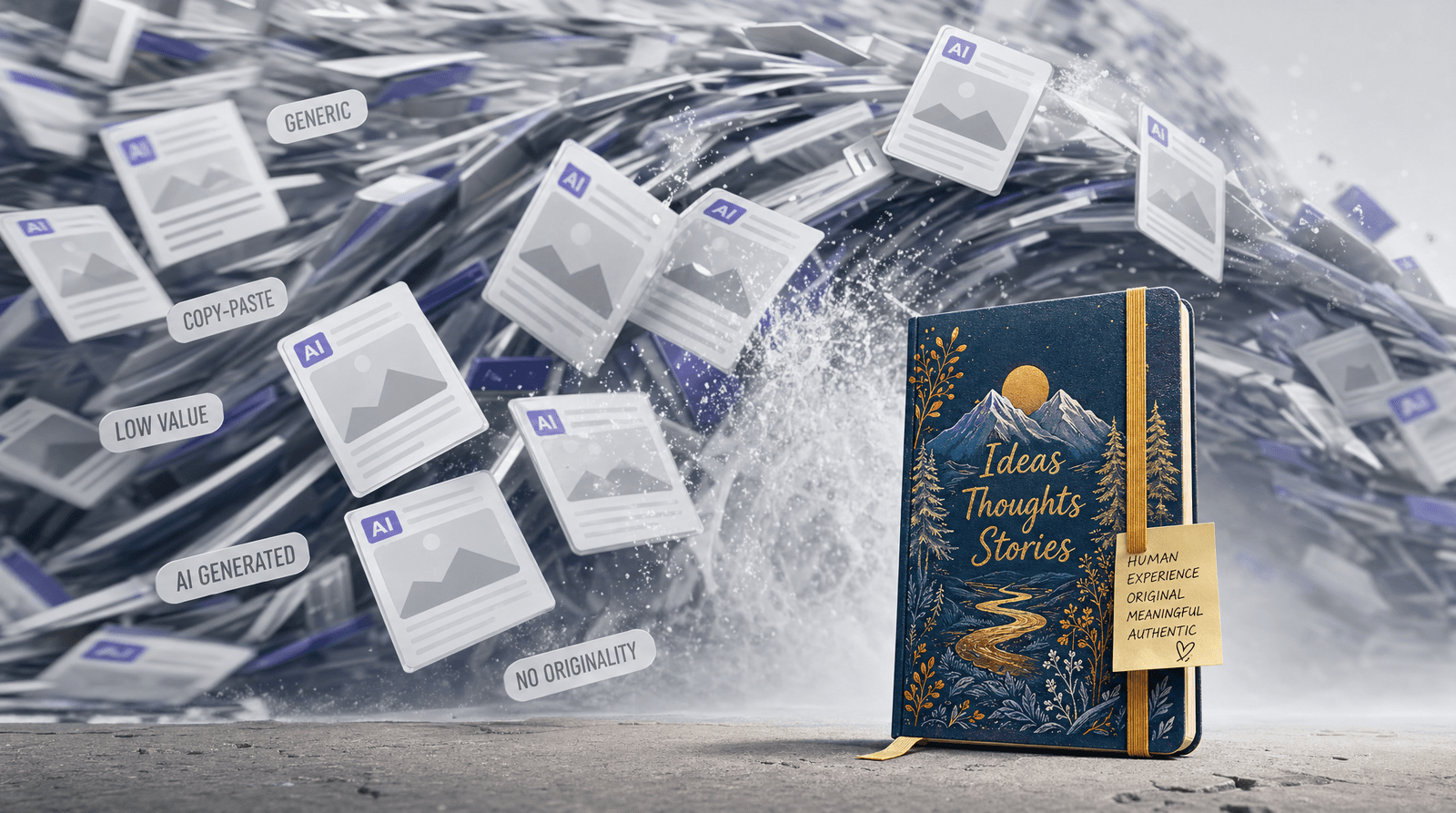
Sometime around the middle of last year, the math quietly flipped.
For the first time in the history of the internet, more new content is now produced by machines than by people. AI-generated articles outnumber human-written ones on most major content farms. AI-generated images flood every stock library. AI-generated comments flood every Reddit thread. AI-generated voiceovers narrate the majority of new YouTube Shorts. AI-generated profile pictures stare back at you from half the cold-email DMs in your inbox.
The discourse has a nickname for this stuff: slop. It's not great content. It's not terrible content. It's the gray-zone middle — competent, derivative, instantly forgettable, and utterly impossible to escape.
If you've been quietly worried that "everything online is starting to feel the same," you're not imagining it. We've crossed a tipping point. And here's the thing nobody saw coming: that tipping point didn't make AI more valuable. It made human more valuable. By a lot.
The Slop Economy, Briefly Explained
The economics of generative AI are now so cheap that producing content has stopped being a meaningful cost center. A single creator with a basic ChatGPT subscription can produce more "good enough" content per day than a team of ten could in 2022. Multiply that across millions of creators, agencies, SEO farms, and engagement-bait operators, and you get the situation we're in: a near-infinite supply of competently generated, almost-identical-feeling content.
This isn't a moral problem. It's a signal problem. When everything looks the same, nothing stands out. When every article opens with the same kind of intro paragraph, every blog post hits the same five bullet points, every LinkedIn post follows the same hook → story → lesson → call-to-action structure — readers stop reading. They scroll. They distrust. They look for cues that there's a real human on the other end and, when they don't find any, they bounce.
The strange consequence: the more content the machines produce, the less attention any individual piece of content earns. The market for attention hasn't grown. The supply has just exploded. Which means each unit of content is worth less than it was two years ago.
Unless, of course, that content is unmistakably human.
What Audiences Are Quietly Doing About It
Look closely at audience behavior over the past year and a pattern emerges. People aren't tuning out the internet — they're tuning out the flat parts of it. The middle. The gray-zone competent stuff. They're routing their attention toward the edges: deeply human creators, niche operators, weird newsletters, podcasts where you can hear the host breathe, link-in-bio pages that look like a real person made them on a Sunday afternoon.
A few measurable shifts that have shown up in the last twelve months:
- Newsletter subscriptions are up sharply for individual creators with strong voices, and down for corporate brands publishing identical-sounding "thought leadership."
- Long-form podcasts — the messy, two-hour kind — are eating the lunch of polished short-form video, particularly among audiences over 25.
- Engagement on brand social posts has tanked. Engagement on creator posts that visibly feature a real person's face, voice, or daily life is up.
- Newsletter open rates are higher for plaintext, conversational emails than for designed HTML "campaigns."
- Saves and shares — the only social metrics that still matter for organic distribution — are increasingly concentrated on content that feels personal, opinionated, or specific.
None of this is happening because audiences read a manifesto and decided to be more thoughtful. It's happening because their pattern-recognition has caught up. Slop has a texture, and people can now feel it without consciously identifying it. Once you can feel it, you stop trusting it.
The signal that gets through the slop is a strong, identifiable, unmistakably human voice. Everyone else is shouting into a sea of indistinguishable shouting.
Why "Just Use AI Better" Is the Wrong Lesson
The reaction most marketers are having to this is to double down on AI — better prompts, better workflows, better fine-tunes, more agents. Produce more, faster, with sharper outputs. The thinking goes: if the field is flooded, the way to win is to outrun the competition.
This is exactly the wrong instinct. It's the digital equivalent of responding to inflation by printing more money.
The right move is the opposite. If your competitors are publishing 50 AI-generated blog posts per month, the leverage isn't in publishing 100. It's in publishing one essay that could only have come from you. Because the ratio of attention-per-piece is shifting so heavily toward identifiably human content, the math now favors fewer, better, weirder pieces over more, cleaner, generic ones.
This doesn't mean abandoning AI. It means using it as a tool inside a clearly human workflow, not as a replacement for the workflow itself. Use it for outlines, for research, for first drafts you then rewrite in your voice, for generating four bio variations you mix into your own version. Don't ship raw model output and call it your work. The audience can tell, even when they can't articulate why.
The quietly successful creators of 2026 aren't running in the AI arms race. They're sitting it out, publishing slower, and earning the disproportionate attention that comes with being recognizably real.
What "Authentic" Actually Looks Like in 2026
"Be authentic" is the kind of advice that sounds great and means nothing. So let's get specific. Here's what the slop-resistant version of an online presence actually has in it:
A specific voice. Not "professional but approachable." Not "warm and conversational." A voice that has idiosyncrasies — turns of phrase, opinions you'd defend at a dinner party, a particular sense of humor. If your content could've been written by any of ten creators in your space, you don't have a voice yet. The fastest way to find one is to write the way you actually talk.
Visible specificity. Real names. Real places. Real numbers. AI tends to default to vague hedges ("many creators report success") because hedges are statistically safer. Humans use specifics ("my last cohort had 23 students; 19 of them shipped a paid product"). Specifics signal I was actually there. Slop never quite has them.
Imperfection on purpose. A typo here and there. A photo that wasn't run through three filters. A bio that mentions you have a weird obsession with Korean banchan or vintage Casio watches. The over-polish that AI defaults to has become a tell. Some friction in your output reads as truthful in a way perfectly smooth content can't.
A consistent face and presence. When was the last time you saw your favorite creator on camera, with their voice, in a context that wasn't a hyper-produced thumbnail? Audiences increasingly need that anchor. The brands that show up faceless in 2026 are slowly losing trust — not because anyone is angry about it, but because there's no one to attach the trust to.
A coherent home base. Your social posts can be ephemeral. But somewhere on the internet, there should be a single, durable, designed-by-you place that says this is me, this is what I do, here's how to find more. Your Liinks page — or whatever link-in-bio you use — is the highest-leverage version of that. It's the most-read, most-shared, most-trafficked pixel real estate of your entire online presence. As we covered in every link is a promise, it's also where authenticity either gets confirmed or quietly evaporates.
The Practical Implications for Your Marketing
If "authenticity is now a premium asset" sounds too abstract, here's what it actually changes about how to spend your time:
Stop scaling content production. Start scaling content distinctiveness. A single piece of writing that nobody else could've produced will out-perform fifty interchangeable ones over a one-year window. Stop measuring posts per week. Start measuring how many of your posts contain something that only you would say.
Invest in slow channels. Email. Long-form podcasts. Communities. Newsletters. These are the places where slop has the hardest time reaching scale and where audiences are actively migrating. Build a list. Build a podcast. Build a discord. Build literally anything where the relationship survives the algorithm.
Make your home base look human. This is the easiest one to act on right now. Open your Liinks page (or whatever link-in-bio you use). Does it look like a generic template, or does it look like you? Are the buttons named like you'd phrase them in a text to a friend? Do the colors match your actual brand or just the default ones? A lot of your brand colors are already saying things you didn't intend, and a lot of your buttons are too. The whole page is a signal — make sure it signals "human" instead of "template."
Show your face. This one feels uncomfortable for a lot of creators, but it's the single most reliable trust signal in 2026. Even one good profile photo, a video clip on your link page, or an "about me" line that says something genuinely revealing changes how visitors read everything else.
Embrace having opinions. The slop-generation algorithms are trained to be agreeable, hedged, and balanced. Real humans aren't. Having a defensible opinion — and being willing to put it in your bio, your headline, your home page — is one of the cheapest, fastest ways to feel unmistakably non-AI.
The Counterintuitive Window
Here's the part that should make you genuinely optimistic: the AI slop wave is also a generational opportunity. For the first time in years, the cost of being noticeably better than your competition has gone down, not up.
Five years ago, standing out required a six-figure production budget, a film crew, a designer, and a content team. Today, standing out requires a willingness to sound like yourself. The slop has set the floor so low that any creator with a recognizable voice and a coherent home base is already above the noise floor.
This is rare. The internet doesn't usually hand creators an asymmetric advantage. But for the next 18-24 months, until audiences fully recalibrate to the new normal, being identifiably human is one of the highest-ROI things you can be online.
The creators who recognize this and lean into it — fewer posts, sharper voice, stronger home base — will compound. The ones who keep optimizing for production volume will keep wondering why their numbers feel quietly worse every quarter.
TL;DR
- The internet has crossed a threshold: machines now generate more new content than people. Most of it is "slop" — competent, derivative, instantly forgettable.
- Audiences can feel the slop, even without naming it. They're routing attention toward identifiably human creators, slow channels (newsletters, podcasts, communities), and personal home bases.
- The right response isn't to use AI harder. It's to publish less, sharper, and weirder — content that could only have come from you.
- Specifics, opinions, voice, face, and a coherent home base are the new authenticity premium. Make sure your Liinks page (or whichever link-in-bio you use) reads as "human," not "template."
- The window for asymmetric gains from being noticeably authentic is open for the next 18-24 months. Use it.
Make One Distinctly-Human Thing This Week
Don't try to overhaul your whole brand. Pick one thing. Rewrite your bio in your actual voice. Record a 30-second video and put it on your link page. Write one essay you wouldn't dare post to LinkedIn. Replace one templated CTA with something you'd actually say.
Then point all of it at a Liinks page that looks like you made it — colors that match your real brand, copy that sounds like your real voice, a layout that reflects what you actually want people to do. Of all the marketing investments you can make in 2026, the one with the highest expected return is also the cheapest: just be visibly, recognizably yourself in a sea of content that isn't.