SEO, But Make It Bio: How to Turn Your ‘About Me’ Section into a Mini Search Magnet

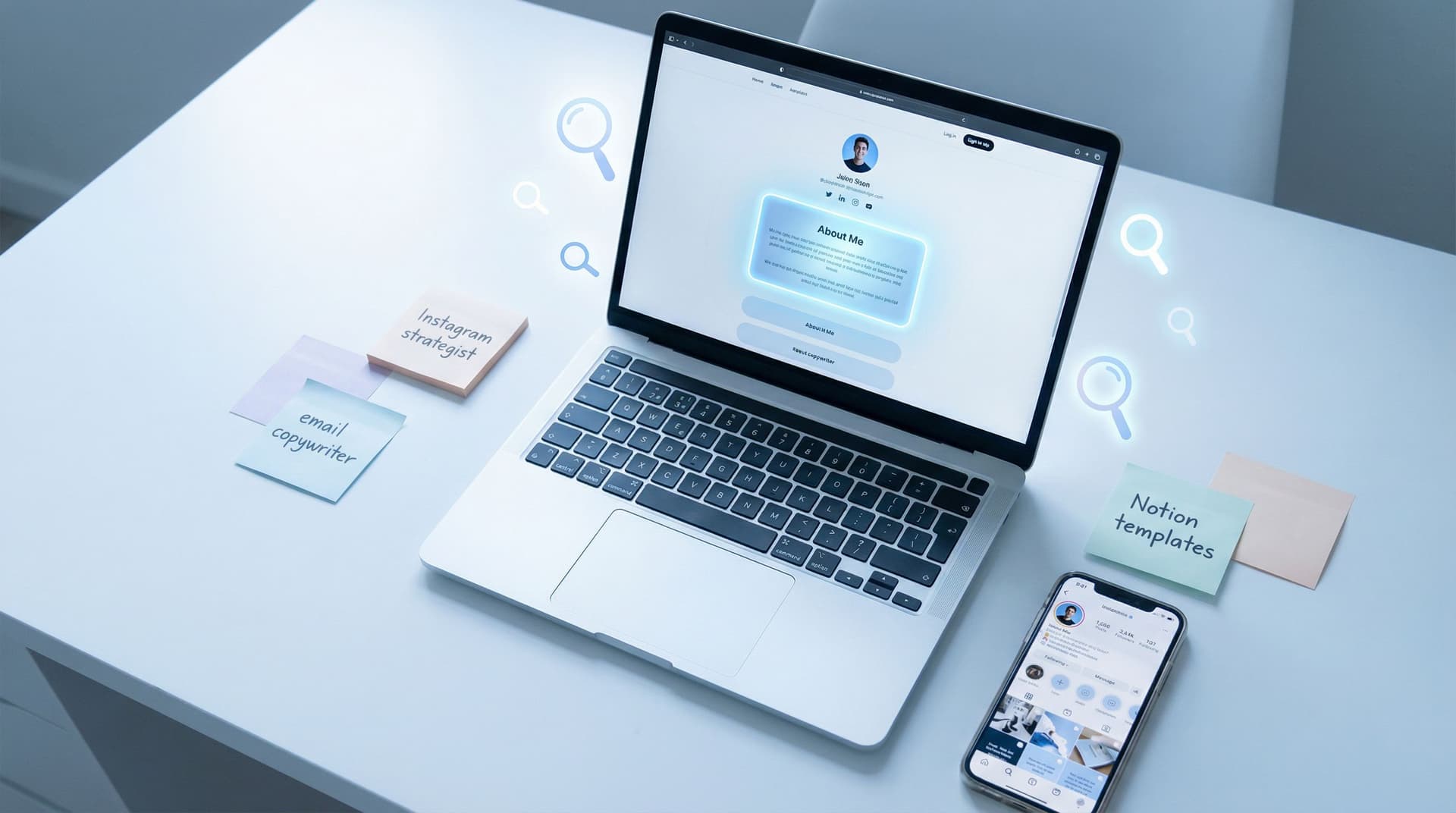
You know that tiny “About” box you filled out in 2019 and haven’t touched since?
Yeah. That thing is quietly doing PR for you every time someone Googles your name, your handle, or “that TikTok girl who teaches Notion but also has a cat named Toast.”
If your bio and About Me are vague, outdated, or written like you were being held hostage by a character limit… you’re leaving search traffic, brand deals, and sales on the table.
This guide is your makeover plan: SEO, but specifically for the little blurbs that follow you everywhere—your About Me, social bios, and your link‑in‑bio intro on tools like Liinks.
We’re turning them into mini search magnets that:
- Help you show up for your name and your niche
- Make it obvious what you actually do (so people stop DM’ing “wait, what’s your job?”)
- Funnel the right people to your offers, content, or inbox
Why Your About Me Is Secretly an SEO Powerhouse
Most people think SEO only lives on big websites and 2,000‑word blog posts.
Meanwhile, your real life looks like this:
- Someone sees your Reel.
- They like you.
- They Google your name or tap your bio.
- They skim one tiny paragraph to decide if you’re worth following, hiring, or buying from.
That paragraph is doing three jobs at once:
- Human job: Tell people who you are and why they should care.
- Search engine job: Give Google and AI tools enough context to understand what you’re about.
- Conversion job: Nudge the right people toward the next step (follow, click, book, buy).
When you treat your About Me like filler text, you miss all three.
Meanwhile, on the SEO side:
- Search engines rely on clear, topical content to understand who you are and what you do.
- “About” and “About Me” pages are increasingly called out by SEO pros as high‑value signals for brand and entity understanding.
- As AI‑powered search layers roll out, tools are pulling from short, descriptive bios to decide which creator, coach, or brand to surface.
Translation: your About Me is no longer just vibes. It’s data.
Step 1: Decide What You Actually Want to Be Found For
Before we touch a single word, you need a positioning decision:
If someone types your name into Google or taps your bio, what do you want to be known for in one sentence?
Not five things. Not your whole life story. One.
Examples:
- “Instagram strategist who helps beauty creators sell digital products.”
- “Strength coach for postpartum moms who want to lift heavy again.”
- “Freelance copywriter who writes launch emails for course creators.”
That one sentence becomes your North Star. It should:
- Include your primary niche or audience (beauty creators, postpartum moms, course creators)
- Hint at your main outcome (sell digital products, lift heavy again, launch emails that convert)
- Use at least one plain‑language keyword someone might actually type (Instagram strategist, strength coach, copywriter)
Write your sentence. Bold it. We’ll recycle it everywhere.
Step 2: Build a Bio That Both Humans and Search Engines Understand
We’re going to build a search‑friendly About Me you can:
- Paste into your Liinks intro
- Adapt for your website About page
- Shorten for Instagram, TikTok, YouTube, LinkedIn, etc.
Think in three layers:
- Hook line (1 sentence) – your North Star sentence.
- Credibility + context (2–3 sentences) – who you help, how, and why you’re not just guessing.
- Next step (1 sentence) – what people should do if they’re the right fit.
A plug‑and‑play About Me template
Fill this in, then we’ll tune it for SEO:
[Your name] is a [your role] who helps [your audience] [main outcome]. After [relevant experience/credentials/story], they now [specific way you deliver the outcome]. When they’re not [on‑brand detail], they’re [another proof point or relatable detail]. Want [result]? Start with [your core offer / free resource].
Example for a creator:
Jade Miller is an Instagram strategist who helps beauty creators turn viral posts into reliable income. After managing campaigns for indie makeup brands and seeing creators undercharge for their influence, she started teaching creators how to package their content into digital products and evergreen funnels. When she’s not filming Reels, she’s inside her membership helping students plan launches that don’t rely on brand deals. Want your content to pay you, not just brands? Start with her free “Beauty Creator Offer Map” workshop.
Now, let’s SEO‑tune it without making it robotic.
Where SEO quietly sneaks in
- Use natural keywords your audience would actually search:
- “Instagram strategist,” not “Insta growth wizard ✨”
- “meal prep recipes for busy parents,” not “foodie chaos gremlin”
- Name your audience and niche clearly:
- “online fitness coaches,” “local coffee shops,” “micro‑influencers,” “wedding photographers”
- Mention formats and platforms you’re known for:
- “Reels,” “TikToks,” “YouTube tutorials,” “Notion templates,” “email sequences”
The goal: if a stranger scanned your bio for 5 seconds, they could answer:
- Who are you?
- Who do you help?
- With what, specifically?
- What should I do next?
If your current About Me can’t pass that test, it’s rewrite time.
Step 3: Turn Your Liinks Intro into a Searchable Snapshot
Your link‑in‑bio tool is usually the first place people land after tapping your profile. That makes your intro section prime SEO real estate—especially if you’re using a customizable setup like Liinks.
Think of your Liinks page as the summary Google wishes it had about you:
- Clear name and handle
- Short, keyword‑rich description
- Obvious proof you’re legit
- Clean paths to your most important actions
What to put at the top of your Liinks page
Right under your name, aim for a 1–3 line blurb that:
- Repeats your North Star sentence (or a tight version of it).
- Adds one or two secondary keywords you care about.
- Points to your core action.
Example:
Instagram strategist helping beauty creators turn Reels into digital product sales. Courses, templates, and launch plans for creators who are done relying on brand deals. Start with the 20‑minute “Reels to Revenue” mini‑training.
Why this works:
- “Instagram strategist,” “beauty creators,” “digital product sales,” and “Reels to Revenue” are all semantic clues about your topic.
- You’re clearly not just “content creator” (too vague for humans and search).
- You immediately tell people where to click first.
If you want to go deeper on how this intro connects with the rest of your page layout, bookmark SEO for Attention Spans Under 8 Seconds: Structuring Your Liinks Page for Skimmers, Scrollers, and Serial Multi-Taskers next.
Step 4: Bake in Trust Signals (These Also Help Search)
Search engines and humans are suspicious in the same ways:
- Who is this person?
- Are they real?
- Have they done this before?
Your About Me and Liinks intro should quietly answer all three.
Easy trust boosters to add to your bio
Pick 2–4 of these and weave them in naturally:
- Years of experience in your niche (even if it started as a hobby)
- Notable clients, brands, or platforms you’ve worked with
- Numbers that show scale: students, downloads, views, revenue generated, campaigns run
- Credentials that actually matter to your audience (certifications, degrees, features)
- Location if local or time zone matters (great for service providers)
Example upgrades:
-
From: “I love helping small businesses grow online.”
To: “I’ve helped over 120 local service businesses turn Instagram followers into booked appointments.” -
From: “I share tips on productivity and planning.”
To: “I create Notion templates and weekly planning systems for ADHD entrepreneurs who want structure without the shame spiral.”
These details:
- Give search engines entity signals (you’re a real person with real work)
- Help algorithms connect you with related topics and brands
- Make humans think, “Okay, this isn’t their first rodeo.”
If you’re specifically courting sponsors, pairing a strong About Me with a proof‑packed Liinks page is exactly what we walk through in The Brand Deal Pre-Game: Turn Your Liinks Page into a Live Case Study That Makes Sponsors Say ‘Yes’ Faster.
Step 5: Sprinkle Smart Keywords Without Sounding Like a Robot
You do not need to stuff your bio with every synonym for “coach” you can think of.
You do need to:
- Use plain language your audience would search
- Repeat a few key phrases consistently across platforms
- Avoid cutesy job titles that confuse everyone (including Google)
A quick keyword sanity check
Ask yourself:
- If someone didn’t know my handle, what would they type to try to find me?
- “wedding photographer Chicago,” “etsy seo coach,” “youtube thumbnail designer,” etc.
- Are those words anywhere in my About Me, Liinks intro, or social bios?
- If not, can I add them in a way that still sounds like me?
Examples:
- “Based in Chicago, I shoot candid, documentary‑style wedding photography for couples who hate posing.”
- “I’m an Etsy SEO coach helping handmade shop owners get found without running ads.”
- “I design scroll‑stopping YouTube thumbnails for creators who are serious about CTR.”
Notice how each one:
- Names a role (photography, coach, designer)
- Names an audience (couples, handmade shop owners, creators)
- Hints at a benefit (hate posing, get found without ads, serious about CTR)
That’s keyword optimization, but make it human.
Step 6: Connect Your Bio to Clear, Search-Friendly Offers
Your About Me doesn’t live alone; it’s the front door to everything else you do.
Once you’ve clarified who you are and who you help, your next job is to show people where to go next—in a way that also reinforces your niche.
On your Liinks page, this might look like:
- A featured button: “Start here: Free 15‑minute training for [audience]”
- A second button: “Work with me: [service] for [audience]”
- A third: “Shop my [templates / presets / resources]”
Your About Me should match these offers:
- If you say you help beauty creators sell digital products, your top link shouldn’t be a random vlog from 2021.
- If you say you’re a local photographer, your first link should make it painfully easy to see your portfolio and inquire.
For a deeper dive on structuring multiple offers without overwhelming people, check out The “One Niche, Many Offers” Blueprint: Using Liinks to Sell Digital Products, Services, and Memberships from a Single Page.
Step 7: Sync Your About Me Across Platforms (So Search Can Actually Recognize You)
Search engines and AI tools love consistency. If your bios say five different things, they have to guess which one is the “real” you.
Make it easy.
Your sync checklist
Update this one short description (with light tweaks for character limits) on:
- TikTok
- YouTube
- Your Liinks page intro
- Your website About page (if you have one)
- Any major directories or platforms you rely on (Podia, Gumroad, Patreon, Substack, etc.)
Keep these elements consistent:
- Name and handle (no random punctuation changes)
- Core sentence about who you help and how
- Primary keywords (e.g., “podcast producer,” “email strategist,” “Notion creator”)
- Primary link (ideally one Liinks hub you can keep updated everywhere)
This doesn’t just help search; it also:
- Makes you look more put‑together to brands and clients
- Reduces the “wait, is this the same person?” confusion
- Saves you time when you update offers (change them once on Liinks, sync that link everywhere)
Step 8: Refresh Quarterly (Your Bio Should Evolve With You)
Your About Me is not a one‑time assignment. It’s more like a seasonal wardrobe: some pieces are timeless, some need to go.
Set a reminder every 3 months to:
- Re‑read your About Me and Liinks intro
- Ask: “Is this still the main thing I want to be found for?”
- Add any new proof points:
- New client results
- Updated numbers (students, downloads, revenue)
- New offers you’re leaning into
If you’re already using AI tools to help with content, you can absolutely use them to help with this refresh. We walk through a full workflow in AI-Optimized, Human-Approved: Using ChatGPT to Batch-Refresh Your Liinks Page for SEO and Conversions.
Pro tip: keep a running doc of phrases that feel like you and keywords that perform well. Each refresh gets easier.
Quick Recap: Your About Me, Upgraded
Let’s boil this down so you can actually do it:
- Pick a North Star sentence that clearly states who you are, who you help, and with what.
- Write a layered bio: hook line → credibility and context → clear next step.
- Use real‑world keywords your audience would type, not just cute titles.
- Add trust signals (numbers, clients, credentials, location) without turning it into a resume.
- Align your Liinks intro and top links with what your bio promises.
- Sync your message across platforms so search and humans see a coherent story.
- Refresh every quarter to reflect your current offers, wins, and focus.
Do that, and your About Me stops being a throwaway box and starts acting like a mini search magnet—one that pulls in the right people and points them toward the right clicks.
Your Next Step (Yes, This Is the Part Where You Actually Do Something)
- Open a blank doc.
- Write your one‑sentence North Star: who you are, who you help, and the main outcome.
- Use the template above to draft a new, grown‑up About Me.
- Log into your Liinks account and:
- Update your intro text with your refreshed bio (or a tight version of it).
- Make sure your top 2–3 links match what your bio says you do.
- Copy that updated bio to your top social platforms.
Give yourself 30 minutes. By the end of it, your “About Me” won’t just sound better—it’ll work harder.
Your content is already doing the heavy lifting. Let your bio and Liinks page finally catch up.